TOEFL speaking topics for 2026: practice questions for the new test
The TOEFL Speaking section changed on 21 January 2026, and most topic lists online are still for the old test. This page is built for the new one: 48 interview questions, Listen and Repeat practice, a model answer and a plan.
By The YoFluent teamUpdated 12 min read
On this page
The new TOEFL Speaking format, explained
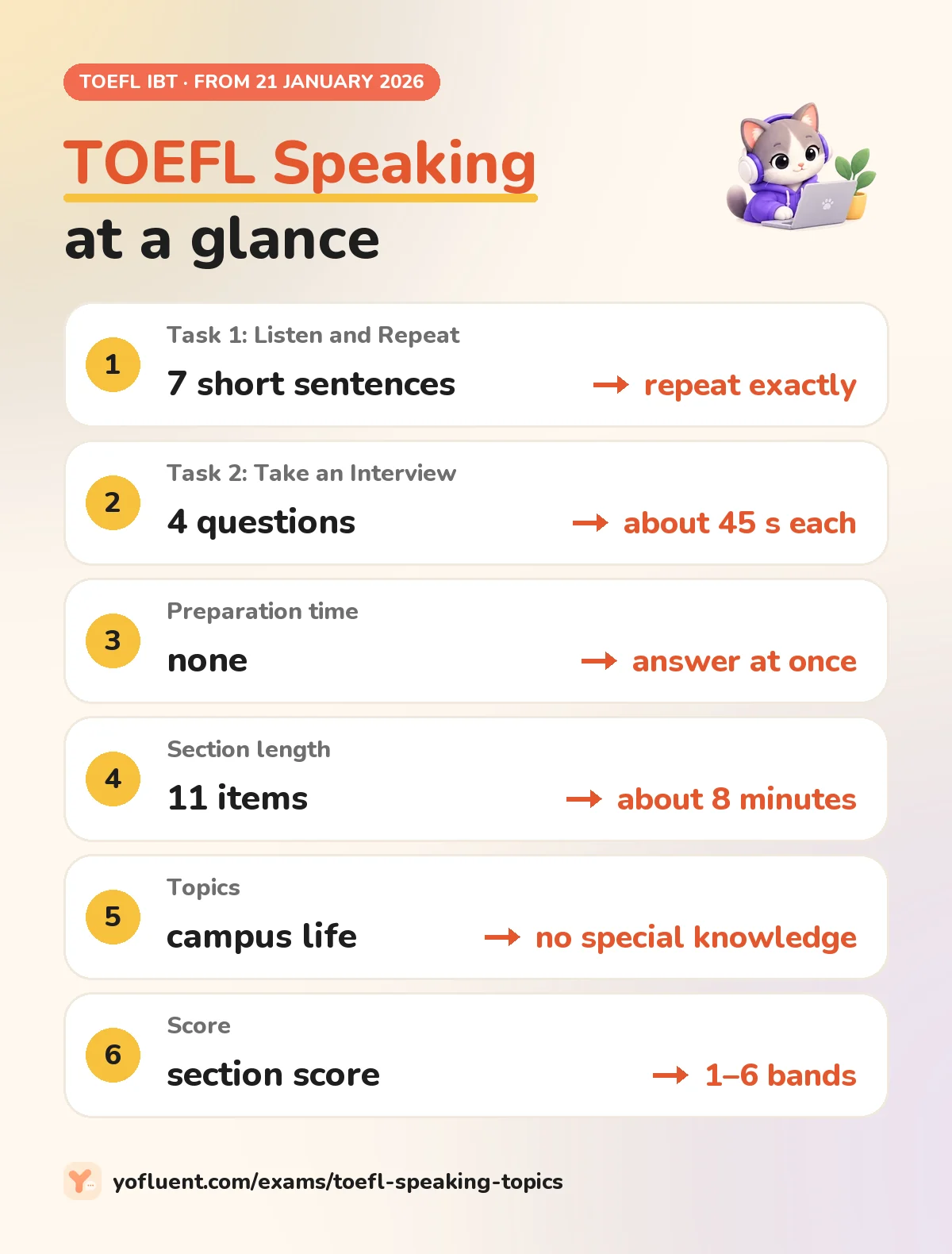
TOEFL iBT Speaking since 21 January 2026
- Length
- About 8 minutes, 11 items
- Task 1
- Listen and Repeat: 7 sentences in one campus scenario
- Task 2
- Take an Interview: 4 questions on one theme
- Answer time
- About 45 seconds per interview answer (reported by test-takers and prep providers)
- Preparation time
- None reported: you answer straight away
- Voices
- North American, British, New Zealand and Australian English
- Score
- Speaking section score on a 1–6 scale
Listen and Repeat measures, in ETS’s words, your ability to process spoken English and produce speech that is accurate and clearly intelligible. It’s really a test of pronunciation, rhythm and listening memory.
Take an Interview measures your ability to communicate clearly, keep a natural pace, and use appropriate vocabulary and grammar. ETS says the first questions ask about facts and your personal experience, and the later ones ask you to give and support opinions about broader issues. The topics on this page follow that order.
The test is also adaptive, so the number of items and the time can vary slightly from person to person.
48 Take an Interview questions (12 topics)
Each set below is one interview: a campus context, then four questions that get harder. Practise them the way the test works: read the context, then answer each question out loud straight away, with a 45-second timer and no notes.
1.Studying for exams
A researcher is studying how university students prepare for exams.
- About youHow do you usually prepare for an important exam?
- Your experienceTell me about a time you studied with other people. How did it go?
- Your opinionDo you think students learn more by studying alone or in groups? Why?
- The bigger pictureSome universities now require a group project in every course. Is this a good idea?
2.The campus library
The university is planning changes to its library and wants students’ views.
- About youHow often do you use a library, and what do you use it for?
- Your experienceDescribe a place where you find it easy to concentrate.
- Your opinionShould libraries replace most printed books with digital ones?
- The bigger pictureLibraries are becoming social spaces, with cafés and group rooms. Is that a positive change?
3.Online and in-person classes
A professor is collecting opinions about online learning.
- About youHave you ever taken a class online? What was it like?
- Your experienceTell me about a teacher whose classes you really enjoyed.
- Your opinionDo you prefer online or in-person classes? Why?
- The bigger pictureShould universities offer complete degrees online, at the same price as campus degrees?
4.Part-time jobs
The careers office is surveying students about work and study.
- About youDo you have a job, or have you had one? What did you do?
- Your experienceWhat has a job or responsibility taught you that school didn’t?
- Your opinionShould full-time students work part-time during the semester?
- The bigger pictureShould universities pay students for work on campus, such as tutoring other students?
5.Clubs and activities
The student union wants to know how students spend their free time.
- About youWhat do you like to do in your free time?
- Your experienceTell me about a club, team or group you’ve been part of.
- Your opinionShould universities give academic credit for activities like sports or volunteering?
- The bigger pictureWhen employers hire graduates, are activities outside class as important as grades?
6.Student housing
The housing office is planning new accommodation for students.
- About youWhere do you live now, and who do you live with?
- Your experienceDescribe a time you had to share a space with someone. What was difficult?
- Your opinionIs it better for first-year students to live on campus or off campus?
- The bigger pictureHousing near universities is getting more expensive. Who should be responsible for solving this?
7.Technology and AI in study
A research team is studying how students use technology.
- About youWhich apps or tools do you use most for studying?
- Your experienceTell me about a time technology helped you learn something.
- Your opinionShould students be allowed to use AI tools to help with their assignments?
- The bigger pictureHow will AI change what universities need to teach?
8.Choosing a subject
An academic advisor is talking to new students about their plans.
- About youWhat subject do you study, or want to study?
- Your experienceWho or what influenced that choice?
- Your opinionShould students choose a subject because they enjoy it or because it leads to good jobs?
- The bigger pictureShould universities require all students to take some courses outside their main subject?
9.The environment on campus
The university’s sustainability team is asking students for ideas.
- About youHow do you usually travel to school or work?
- Your experienceDescribe something you do to reduce waste.
- Your opinionShould universities ban single-use plastics on campus?
- The bigger pictureShould universities lead the way on environmental issues, or is that the government’s job?
10.Studying abroad
The international office is promoting exchange programmes.
- About youHave you travelled to another country? Where did you go?
- Your experienceDescribe a time you had to adapt to a new place or culture.
- Your opinionIs studying abroad worth the cost?
- The bigger pictureShould time abroad be a required part of some degrees, such as languages or business?
11.Stress and well-being
Student services is reviewing its support for students.
- About youWhat do you do to relax after a busy day?
- Your experienceTell me about a stressful time in your studies and how you handled it.
- Your opinionShould universities limit how much homework students get each week?
- The bigger pictureShould counselling and mental health services be free for all students?
12.Internships and experience
A careers advisor is discussing work experience with students.
- About youHave you done an internship or volunteer work? What was it?
- Your experienceDescribe a skill you learned outside the classroom.
- Your opinionShould internships always be paid?
- The bigger pictureFor some careers, is work experience more valuable than a degree?
A model answer, and how it’s built
Question: Do you think students learn more by studying alone or in groups? Why?
Answer: I think most students learn more in groups, at least for difficult subjects.
Reason: The main reason is that explaining an idea to someone else forces you to understand it properly.
Example: For example, last year I was struggling with statistics, so I joined a study group with three classmates. Each week one of us explained a topic to the others, and I realised that teaching was the best way to find the gaps in my own knowledge.
Wrap-up: Of course, you need time alone to review. But for understanding, rather than memorising, I’d say groups work better.
That’s about 100 words: roughly 45 seconds at a calm pace. Notice what makes it work: it answers in the first sentence, gives one clear reason, supports it with a short personal story, and ends by recognising the other side. You don’t need two reasons; one well-developed reason is better than two thin ones.
Listen and Repeat: practice sentences and tips
In the test you hear seven sentences from one campus situation, getting longer as you go. Practise with these: ask someone to read them to you, or record yourself reading them, wait a few seconds, then repeat from memory.
Scenario A: a library welcome talk
- Welcome to the main campus library.
- Please show your student card at the desk.
- Quiet study rooms are on the second floor.
- You can borrow up to ten books at a time.
- Laptops can be charged at the tables near the windows.
- If you need help finding a source, ask a librarian at the information desk.
- Group rooms can be booked online for up to two hours, but please cancel if you can’t come.
Scenario B: a campus tour
- This is the student center.
- The cafeteria is open until nine.
- You can print documents on the first floor.
- The bookstore sells textbooks and campus clothing.
- Free shuttle buses leave from the stop outside every fifteen minutes.
- Most students meet their academic advisor here at the start of each semester.
- If you lose your student card, report it at the front desk so we can cancel it and print a new one.
How to do well
- Remember meaning, not words. Long sentences are impossible to hold word by word. Picture the situation ("cancel the room if you can’t come") and rebuild the sentence from it.
- Hear the chunks. Sentences come in groups of words: If you lose your student card | report it at the front desk | so we can cancel it. Repeat chunk by chunk.
- Copy the rhythm and the links. Natural speech joins words: report‿it‿at sounds like "re-por-ti-tat". Our guide to linking sounds in English explains the six patterns you’ll hear.
- Keep going if you miss a word. A fluent sentence with one small gap usually sounds better than a long pause while you search for it.
| You write | It sounds like |
|---|---|
| report‿it‿at the front desk | re-por-ti-tat the front desk |
| cancel‿it | can-ce-lit |
| up to ten books‿at‿a time | up to ten boo-ksa-ta time |
Three links from the practice sentences above (British pronunciation; in American English the t between vowels sounds like a soft d: re-por-di-dat). Spotting them makes the sentences much easier to remember.
How TOEFL Speaking is scored now
Since January 2026, each TOEFL section, including Speaking, gets a score on a 1–6 scale, and your overall score is the average of the four sections, rounded to the nearest half band. For a two-year transition period, score reports also include a comparable overall score on the old 0–120 scale.
According to ETS, strong interview answers:
- address the question with a clear, coherent response, with support and elaboration;
- are intelligible and fluent, at a natural pace;
- use a good range of vocabulary and grammar, accurately.
For Listen and Repeat, what counts is repeating the sentence accurately and clearly.
Are old TOEFL speaking topics still useful?
Partly. If you have older books or websites:
- Old Task 1 opinion questions ("Do you prefer…", "Do you agree…") are still good practice for interview questions 3 and 4. Answer them in 45 seconds with no preparation, not the old 15 seconds of preparation.
- Old Tasks 2–4 (read a passage, listen to a lecture, summarise) are no longer part of Speaking. Skip them for speaking practice.
A 4-week TOEFL Speaking practice plan
- Week 1: Listen and Repeat. Ten minutes a day: play a podcast or lecture, pause after each sentence, and repeat it. Start with short sentences, then longer ones.
- Week 2: Interview sets 1–4. Answer every question out loud with a 45-second timer. Record yourself and listen back once.
- Week 3: Sets 5–8. Focus on structure (answer, reason, example, wrap-up) and on one pronunciation problem. Our comparison of pronunciation apps can help you find the right tool.
- Week 4: Sets 9–12, test conditions. No pauses between questions, no notes, and do a full Listen and Repeat scenario first. Do it three times this week.
The most important habit is speaking out loud every day. Reading model answers silently doesn’t train the skills TOEFL scores: fluency and clear pronunciation under time pressure.
Frequently asked questions
What are the TOEFL speaking tasks in 2026?
Since 21 January 2026, TOEFL iBT Speaking has two tasks: Listen and Repeat, where you repeat seven short sentences from a campus situation, and Take an Interview, where you answer four questions in a simulated interview.
How long is the TOEFL speaking section now?
About 8 minutes for 11 items, according to ETS. The test is adaptive, so the exact time can vary slightly.
Is there preparation time in the new TOEFL speaking section?
Test-takers and prep providers report no preparation time: you answer each interview question straight away, with about 45 seconds to speak.
How is TOEFL speaking scored now?
The Speaking section gets a score on a 1 to 6 scale, like the other sections. The overall score is the average of the four sections. For two years after January 2026, reports also include a comparable 0 to 120 overall score.
What topics come up in TOEFL speaking?
Academic and campus life: studying, classes, libraries, housing, jobs, clubs, technology and student well-being. Interview questions start with your own experience and move to your opinion on broader issues. No special knowledge is needed.
Are old TOEFL speaking topics still useful?
The old independent opinion questions are still good practice for the later interview questions. The old integrated tasks, where you summarised a reading and a lecture, are no longer part of the Speaking section.
Practise answering out loud, with feedback
Talk through interview-style questions with an AI tutor and get scores for pronunciation, fluency, grammar and vocabulary after every call. Free for 3 days.
Start your free trialSources
- TOEFL iBT Speaking section, ETS
- TOEFL iBT test content, ETS
- Inside the TOEFL iBT updates: validity by design, ETS
- Test of English as a Foreign Language, Wikipedia
- TOEFL Speaking Interview 2026, TOEFL Mock Tests
- TOEFL Speaking 2026: new format and tasks, MySpeakingScore