Word stress in English: 6 rules, examples and practice
In every English word of two or more syllables, one syllable is stronger than the others. Put the stress in the wrong place and even correct sounds can be hard to understand. These six rules cover most words.
By The YoFluent teamUpdated 9 min read
On this page
Why word stress matters
Listeners recognise English words largely by their stress pattern. If you say “comFORtable” instead of COMfortable, people may not understand the word at first, even if every sound is right. Stress can also change the meaning or the word class:
- DEsert (a dry place) vs deSSERT (sweet food)
- PREsent (a gift, or now) vs preSENT (to show)
- REcord (a noun) vs reCORD (a verb)
6 word stress rules
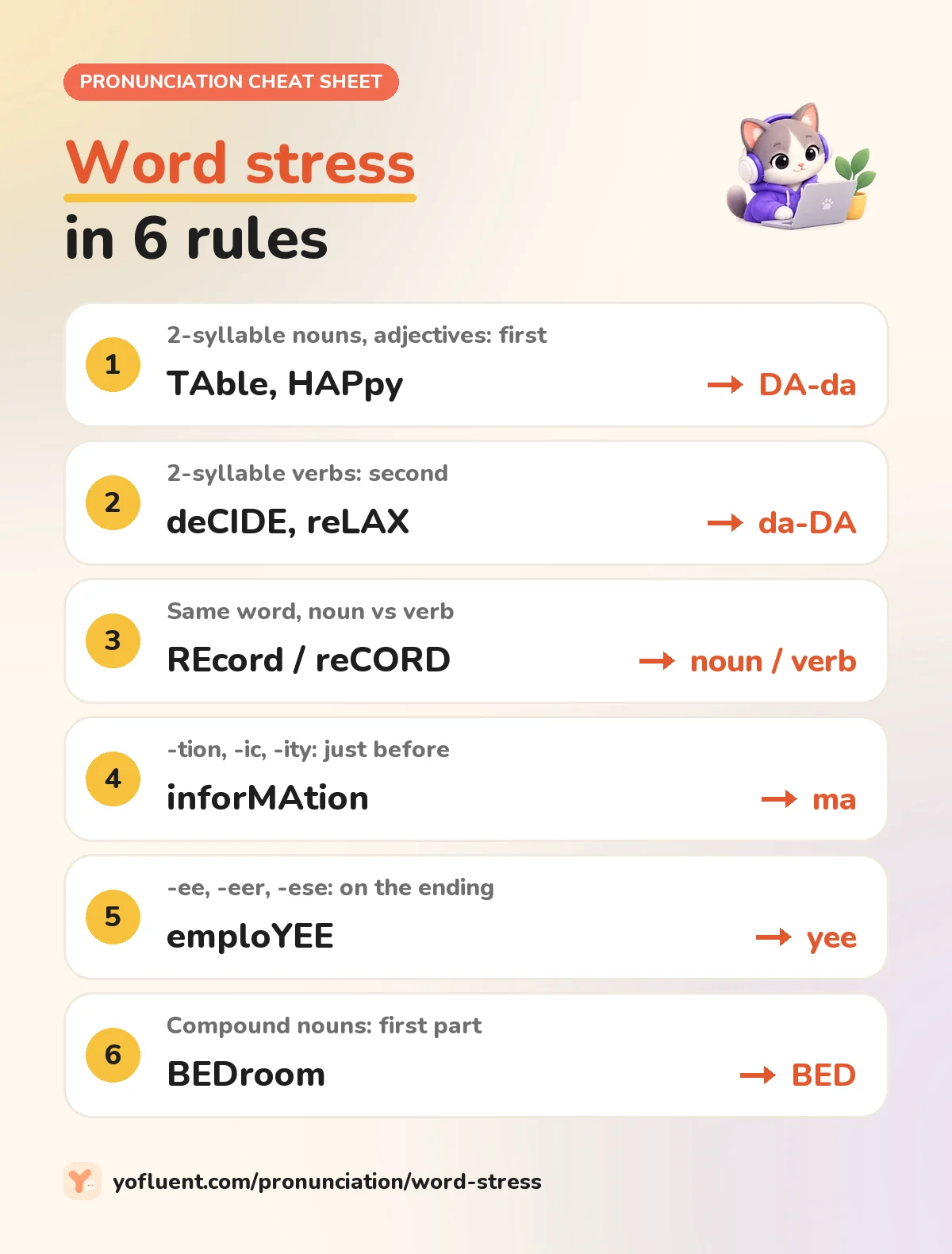
1. Two-syllable nouns and adjectives: stress the first syllable
TAble, WAter, HAPpy, BUSy, DOCtor, MOther, PREtty, CLEver. Exceptions: hoTEL, caREER, aLONE.
2. Two-syllable verbs: stress the second syllable
deCIDE, reLAX, beGIN, forGET, exPLAIN, inVITE, aGREE. Exceptions: OPen, LISten, VISit, HAPpen.
3. Noun and verb pairs: noun first, verb second
| Noun | Verb |
|---|---|
| a REcord | to reCORD |
| a PREsent | to preSENT |
| an OBject | to obJECT |
| an INcrease | to inCREASE |
| PROgress | to proGRESS |
| a CONtract | to conTRACT |
| an IMport | to imPORT |
| a PERmit | to perMIT |
4. Words ending in -tion, -sion, -ic, -ity, -ical: stress the syllable just before
inforMAtion, deCIsion, draMAtic, ecoNOmic, aBIlity, elecTRIcity, poLItical.
5. Words ending in -ee, -eer, -ese, -ique: stress the ending
emploYEE, refuGEE, engiNEER, volunTEER, ChiNESE, JapaNESE, uNIQUE, techNIQUE.
6. Compound nouns: stress the first part
BEDroom, TOOTHbrush, BLACKboard, BUS stop, AIRport, LAPtop. Compare a BLACKboard (in a classroom) with a black BOARD (any board that is black).
Stress moves in word families
When you add an ending, the stress often moves. Learn these families together:
| Word | Related words |
|---|---|
| PHOtograph | phoTOgrapher · photoGRAPHic |
| eCOnomy | ecoNOmic · eCOnomist |
| POlitics | poLItical · poliTIcian |
| aCAdemy | acaDEmic |
| ENergy | enerGEtic |
| deMOcracy | demoCRAtic |
Commonly mis-stressed words
These everyday words are often stressed wrongly by learners. Say each one out loud with the capital syllable strong:
| Correct | Common mistake |
|---|---|
| COMfortable | comFORtable |
| VEGetable | veGEtable |
| deVELopment | DEvelopment |
| deTERmine | determINE |
| caREER | CAreer |
| hoTEL | HOtel |
| eVENT | EVent |
| INteresting | interESTing |
| CHOColate | choCOLate |
| WEDnesday | wedNESday |
Some words drop a syllable in fast speech: COMfortable sounds like “COMF-tuh-bul”, CHOColate like “CHOC-lit”, WEDnesday like “WENZ-day”.
Unstressed syllables are weak
Stress isn’t only about making one syllable strong; it’s also about making the others weak. In most unstressed syllables the vowel becomes a short “uh” sound, the schwa: baNAna sounds like “buh-NAH-nuh”, and DOCtor like “DOC-tuh”.
Many learners give every syllable the same weight, especially speakers of languages where all syllables are similar in length. Weakening the unstressed syllables often makes a bigger difference to how natural you sound than getting every sound perfect.
How to practise word stress
- Check the dictionary mark. Dictionaries show stress with a small mark (ˈ) before the stressed syllable: /ˈteɪbl/. Note it whenever you learn a new word.
- Tap or clap the rhythm. Tap strongly on the stressed syllable and lightly on the others: ba-NA-na = tap-TAP-tap.
- Exaggerate first. Make the stressed syllable much longer and louder than feels natural, then relax it.
- Learn word families together, like PHOtograph, phoTOgrapher, photoGRAPHic.
- Use the words in sentences and record yourself. Stress is easier to hear when you listen back.
Word stress works together with how words join in sentences: see linking sounds in English, and how your pitch moves in English intonation. To put it together in one accent, see American accent training. Working on a specific sound too? Try the TH sound.
Frequently asked questions
What is word stress in English?
Word stress is the extra emphasis on one syllable in a word. The stressed syllable is longer, louder and higher in pitch than the others, as in ba-NA-na, where the middle syllable is stressed.
What are the rules of word stress?
Most two-syllable nouns and adjectives stress the first syllable (TAble), most two-syllable verbs stress the second (deCIDE), words ending in -tion or -ic stress the syllable just before (inforMAtion), words ending in -ee stress the ending (emploYEE), and compound nouns stress the first part (BEDroom).
Why is word stress important?
Listeners recognise words largely by their stress pattern, so wrong stress can make a correct word hard to understand. Stress can also change meaning, as in DEsert and deSSERT, or change a noun into a verb, as in REcord and reCORD.
How do I know where the stress is in a word?
Use the rules for common patterns, and check new words in a dictionary, which marks the stressed syllable with a small symbol (ˈ) before it and usually has audio you can listen to.
Does word stress change meaning?
Sometimes. In noun and verb pairs such as REcord and reCORD or PREsent and preSENT, stress shows the word class, and in pairs like DEsert and deSSERT it distinguishes different words.
Get feedback on your stress and rhythm
Speak with an AI tutor in American or British English and get pronunciation feedback after every call. Free for 3 days.
Start your free trialSources
- Stress (linguistics), Wikipedia
- Stress and vowel reduction in English, Wikipedia
- Initial-stress-derived noun, Wikipedia
- Schwa, Wikipedia