Linking sounds in English: the 6 rules of linked speech, with examples
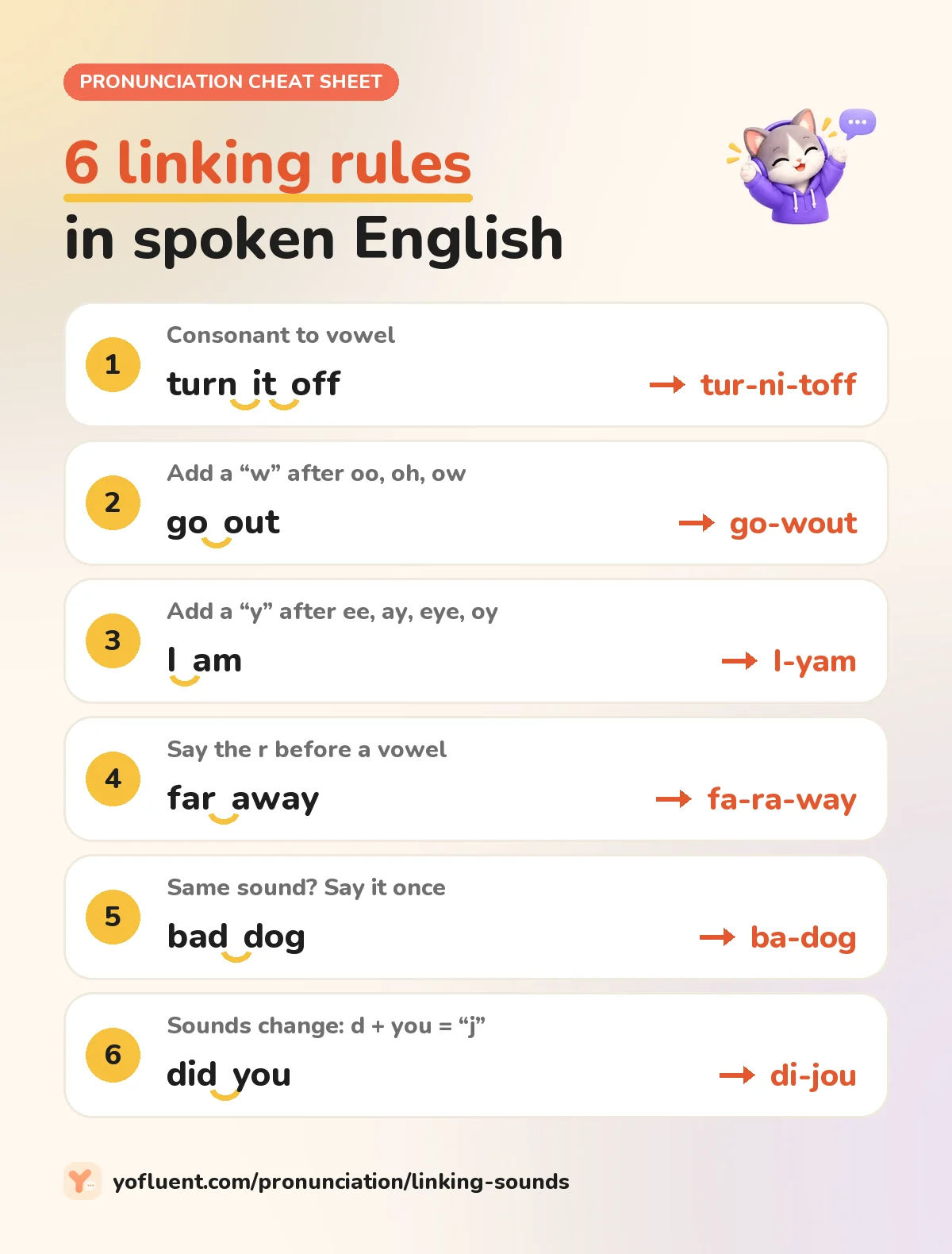
Native speakers don’t say words one by one. They join them, so “turn it off” sounds like “tur-ni-toff”. These joins are called linking, or linked sounds, and they are one part of connected speech. Here are the six ways English links words, with every example to listen to in an American and a British accent and slowly, when not to link, and how to practise until it’s automatic.
By The YoFluent teamUpdated 10 min read
On this page
- What linking is, and why it matters
- Rule 1: Consonant to vowel
- Rule 2: Vowel to vowel with a “w”
- Rule 3: Vowel to vowel with a “y”
- Rule 4: Linking r (and the British “intrusive r”)
- Rule 5: Same sound? Say it once
- Rule 6: Sounds that change when words meet
- When not to link
- Linking and connected speech
- Linking makes listening harder: these pairs sound the same
- How to practise linking: 5 steps
- Linking habits by first language
- FAQ
- Sources
What linking is, and why it matters
In writing, words have spaces between them. In speech, they mostly don’t. English speakers group words into short phrases and say each phrase in one breath, joining the end of each word to the start of the next. Teachers call this linking, and it’s one part of connected speech, along with weak forms ("to" said as "tuh") and dropped sounds.
Linking matters for two reasons:
- Listening. If you expect clear gaps between words, natural speech sounds like one long word. Learning the rules is the fastest way to understand fast English, films and phone calls.
- Speaking. Without linking, speech sounds choppy and robotic, even when every sound is correct. With it, you sound fluent and relaxed.
In the examples below, ‿ marks a link (dictionaries use the same symbol), and the respelling in orange shows how it sounds. The respellings aren’t phonetic spellings; they show where the syllables start once the words are joined.
Rule 1: Consonant to vowel
When a word ends in a consonant sound and the next word starts with a vowel sound, the consonant moves across and starts the next syllable. This is the most common link in English, and the one that makes the biggest difference.
| You write | It sounds like |
|---|---|
| turn‿it‿off | tur-ni-toff |
| pick‿it‿up | pi-ki-tup |
| check‿it‿out | che-ki-tout |
| an‿apple | a-napple |
| hold‿on | hol-don |
| look‿at‿it | loo-ka-tit |
| take‿it‿easy | ta-ki-teasy |
| find‿out | fine-dout |
Think sounds, not letters: “have‿a” links (have ends in a v sound), and “an‿hour” links too, because “hour” starts with a vowel sound.
Tip: say the phrase as if it were a single word. "Pi-ki-tup" is easier to say quickly than "pick. it. up.", which is exactly why native speakers do it.
Rule 2: Vowel to vowel with a “w”
Two vowel sounds side by side are hard to join smoothly, so English slips in a light w sound. This happens after vowels said with rounded lips: oo (do, two, who), oh (go, so, know) and ow (how, now).
| You write | It sounds like |
|---|---|
| go‿out | go-wout |
| do‿it | doo-wit |
| who‿is | who-wiz |
| two‿apples | two-wapples |
| so‿easy | so-weasy |
| how‿about | how-wabout |
Keep the w light. It’s a glide from one vowel to the next, not a full “w” like in “water”.
Rule 3: Vowel to vowel with a “y”
After vowels said with spread lips, the glide is a light y instead: ee (he, see, three), ay (they, say), eye (I, my, why) and oy (boy, enjoy).
| You write | It sounds like |
|---|---|
| I‿am | I-yam |
| he‿asked | he-yasked |
| see‿it | see-yit |
| my‿own | my-yown |
| they‿are | they-yare |
| three‿eggs | three-yeggs |
You don’t need to memorise which vowels take w and which take y. Say the first vowel and keep your lips where they are as you move to the second: rounded lips make a w, spread lips make a y.
Rule 4: Linking r (and the British “intrusive r”)
This one depends on your accent.
- American English pronounces every written r, so a final r simply links like any consonant (rule 1): far‿away → fa-ra-way, more‿often → mo-roften.
- British English (standard southern accent) doesn’t say a final r: "far" is "fah". But the r comes back when the next word starts with a vowel. That’s the linking r.
| You write | It sounds like |
|---|---|
| far‿away | fa-ra-way |
| more‿often | mo-roften |
| where‿is‿it | whe-ri-zit |
| after‿all | afte-rall |
| four‿o’clock | fo-ro’clock |
Many British speakers go one step further and add an r between vowels even where there’s no r in the spelling: law and order → law-rand order, the idea of → the idea-rof. This is the intrusive r. It’s normal in British speech, but you don’t need to produce it. Just recognise it, so it doesn’t confuse you when you listen.
Rule 5: Same sound? Say it once
When one word ends with the same consonant sound that starts the next, you say it once, not twice. How you do that depends on the sound:
- Stop sounds (p, b, t, d, k, g) can’t be stretched. Close your mouth for the first one, hold it a moment, then release only once: bad‿dog → ba-dog, black‿coat → bla-coat.
- Long sounds (s, f, l, m, n, sh) can. Make one sound that lasts a little longer: this‿song → thi-ssong, feel‿lucky → fee-llucky.
| You write | It sounds like |
|---|---|
| bad‿dog | ba-dog |
| red‿dress | re-dress |
| black‿coat | bla-coat |
| feel‿lucky | fee-llucky |
| some‿milk | so-mmilk |
| this‿song | thi-ssong |
Similar sounds link the same way: “cheese‿sandwich” (z + s), “good‿time” (d + t), “big‿cat” (g + k).
Rule 6: Sounds that change when words meet
Some sounds don’t just join, they turn into a different sound. These are the changes you’ll hear most.
t or d + you → “ch” or “j”
| You write | It sounds like |
|---|---|
| did‿you | di-jou |
| would‿you | wou-jou |
| won’t‿you | won-chu |
| nice to meet‿you | nice to mee-chu |
The American flap t
In American English, a t between two vowel sounds becomes a quick, soft sound like a light d, even across words. British speakers usually keep a clear t, or replace it with a short catch in the throat.
| You write | It sounds like |
|---|---|
| get‿it | ge-dit |
| a lot‿of | a lo-dov |
| what‿is‿it | wha-di-zit |
| check‿it‿out | che-ki-dout |
These are American pronunciations. In British English: ge-tit, a lo-tov, wha-ti-zit.
Dropped t and d
Between two consonants, t and d often disappear: next day → nex day, last night → las night, must be → mus be, hand bag → han bag.
n becomes m or ng
Before p, b and m, an n moves to the lips and sounds like m: ten people → tem people, in bed → im bed. Before k and g it becomes ng: in case → ing case.
When not to link
Linking happens inside a phrase. Linking everything is a common mistake that makes you harder to understand. Don’t link:
- Across a pause. At a comma or full stop, stop: "When I got home, | I ate." not "ho-mI ate".
- When you stress a word. "I said ten, | not eleven." A tiny break before a stressed word makes it stand out.
- Numbers, names and spelling. "Room four | eight | one", "It’s Ann | Ellis". Clarity beats flow.
- When it changes the meaning. "an aim" and "a name" can sound identical when linked. If there’s a risk of confusion, separate the words slightly.
Linking and connected speech
Linking is one part of connected speech: everything that happens to words when they’re spoken naturally in a flow. The other main parts are:
- Weak forms: small words lose their full vowel. to becomes “tuh”, and becomes “n”, can becomes “kn” (“I kn swim”).
- Elision: sounds disappear, as in rule 6 (next day → “nex day”).
- Assimilation: sounds change to fit their neighbours, as in rule 6 (ten people → “tem people”, did you → “di-jou”).
- Stress and rhythm: key words are stressed and the small words between them are said quickly.
Linking is the easiest of these to learn and makes the biggest difference, which is why it’s the place to start.
Linking makes listening harder: these pairs sound the same
Because of linking, the boundaries between words are invisible in fast speech. Native speakers use context to decide. These pairs can sound almost identical:
- ice cream / I scream
- a name / an aim
- a nice man / an ice man
- that stuff / that’s tough
- grade A / grey day
When you can’t understand a fast phrase, try moving the consonants in your head: "wha-di-zit" becomes "what is it" once you move the d back to "what" and turn it into a t.
How to practise linking: 5 steps
- Mark the links. Take a short sentence and draw a ‿ wherever one of the six rules applies.
- Say it slowly, linked. Slow down but keep the joins: "pi... ki... tup", never "pick... it... up".
- Speed up gradually until you reach normal speed without losing the links.
- Shadow. Find the sentence (or a similar one) in a film, podcast or on YouGlish and repeat right after the speaker, copying the rhythm.
- Use it in conversation. Drills train your mouth; conversation makes it automatic. Pick one rule a week and listen for it in your own speech.
Preparing for TOEFL? Its Listen and Repeat task is largely a linking test; see our TOEFL speaking topics for 2026.
Practise with these everyday sentences:
| You write | It sounds like |
|---|---|
| I’ll pick‿it‿up‿at‿eight. | I’ll pi-ki-tu-pa-teight. |
| Can‿I have‿an‿orange juice? | Ca-nI ha-va-norange juice? |
| Did‿you get‿it? | Di-jou ge-dit? (US) |
| Let me think‿about‿it. | Let me thin-ka-bou-tit. |
| Turn‿it‿off and go‿out. | Tur-ni-toff and go-wout. |
| We ate‿out‿on Friday. | We-yay-tou-ton Friday. |
Linking habits by first language
Your first language decides which rule is hardest for you. Find yours:
| First language | The habit | What to do |
|---|---|---|
| Spanish, Italian, French | Your language already links consonant to vowel (French liaison is the same idea), which helps. But an extra “e” before s + consonant breaks links: “this‿espoon”. | Use your instinct for rule 1. Start “s” words with the s: this‿spoon. |
| Portuguese | An extra “i” after final consonants: “pick-i it up”, “Facebook-i”. | Move the final consonant to the next word instead: pi-ki-tup. |
| German, Arabic | A small catch in the throat before every word that starts with a vowel: “an | apple”. | Practise rule 1 pairs until the catch disappears: a-napple. |
| Japanese | An extra vowel after consonants: “bado dogu”, “pikku itto”. | End words on the consonant and pass it on: ba-dog, pi-kit. |
| Vietnamese, Chinese, Thai | Final consonants are dropped or not released, so there’s nothing to link. | Say the final consonant fully, then move it to the next word: loo-ka-tit. |
| Hindi, Urdu | Every word gets equal weight, so words stay separate. | Group words into short phrases and link inside each phrase. |
Frequently asked questions
What are linking sounds (linked sounds) in English?
Linking sounds, also called linked sounds, are the way English speakers join the end of one word to the start of the next, so a phrase sounds like one unit. For example, "turn it off" sounds like "tur-ni-toff", and "go out" sounds like "go-wout".
What are the types of linking in English?
There are six common types: consonant to vowel, a w sound between vowels, a y sound between vowels, linking r, saying a repeated consonant once, and sound changes such as "did you" becoming "di-jou".
Do I need to link words to be understood?
No. Clear individual sounds matter more. But linking makes you sound fluent and natural, and learning it is the fastest way to understand fast native speech.
Do Americans use the intrusive r?
Generally no. American English pronounces every written r, so a final r simply links to the next vowel. The intrusive r, as in "law-r-and order", is typical of British and some other non-rhotic accents.
What is the difference between linking and connected speech?
Connected speech is everything that happens to words in natural speech. Linking is one part of it. The others include weak forms, where small words shrink, and elision, where sounds disappear, as in "las night" for "last night".
How long does it take to learn linking?
Most learners can use consonant-to-vowel linking within a week or two of daily practice. Making all six rules automatic in conversation takes longer and comes from speaking regularly, not only from drills.
Practise linking in real conversation
Talk with an AI tutor in American or British English and get feedback on your pronunciation and fluency after every call. Free for 3 days.
Start your free trialSources
- Connected speech, Wikipedia
- Linking and intrusive R, Wikipedia
- Flapping, Wikipedia
- Yod-coalescence, Wikipedia
- Elision, Wikipedia
- Assimilation (phonology), Wikipedia
- Juncture, Wikipedia
- Glottal stop, Wikipedia
- Linking in English, Oxford Online English
- Introduction to linking, Pronuncian