The TH sound in English: how to pronounce voiced and voiceless TH
English has two TH sounds, and most languages have neither. Here’s how to make both, how to know which one a word uses, word lists, the mistakes speakers of your language usually make, and practice that fixes them.
By The YoFluent teamUpdated 9 min read
On this page
How to make the TH sound, step by step
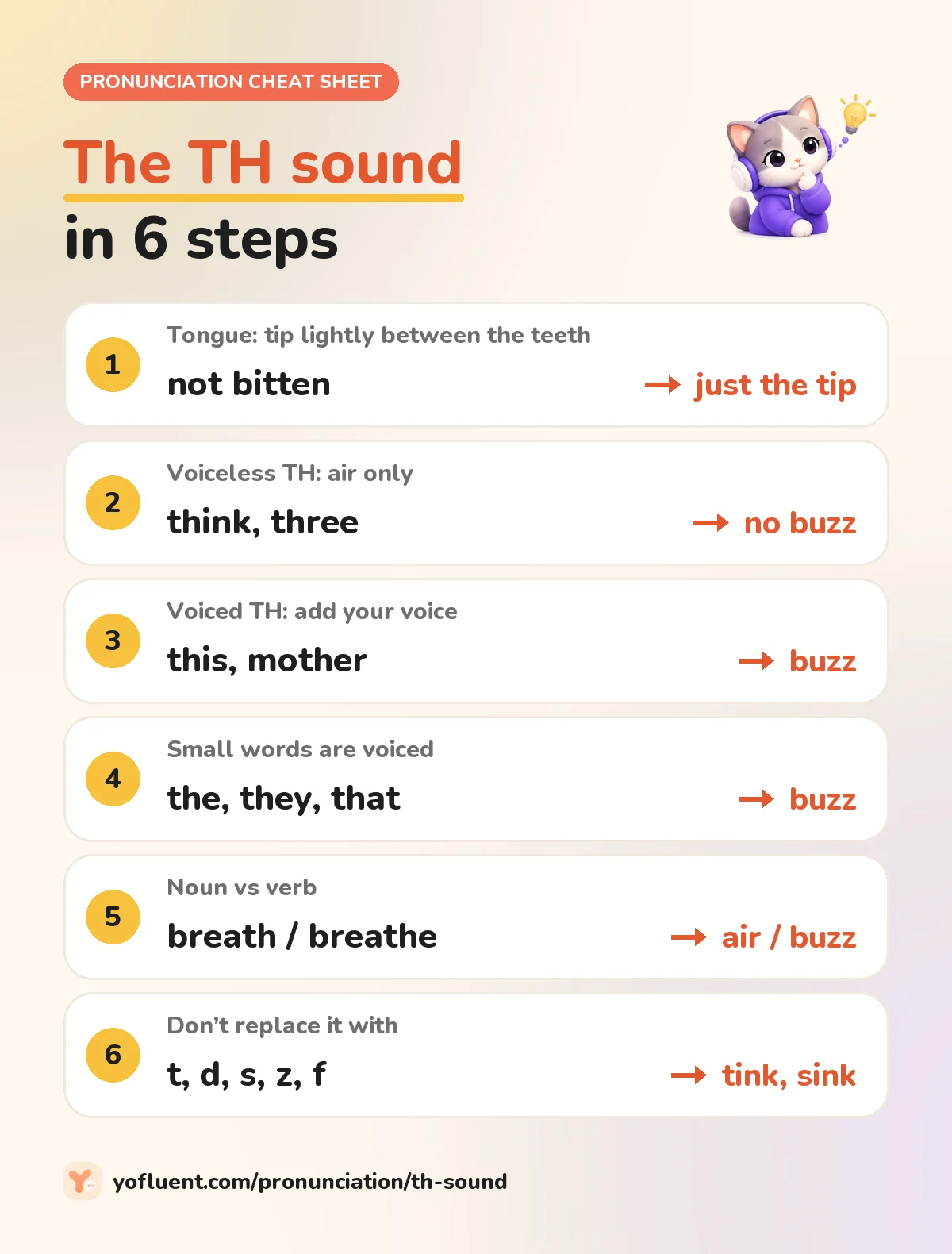
- Relax your tongue and let the tip rest lightly between your top and bottom teeth. Only a little of the tongue shows; don’t bite it or push it far out.
- Blow air gently over the tongue, between the tongue and your top teeth. You should hear a soft hiss. That’s the voiceless TH, as in think.
- Now add your voice. Keep the same position and hum. You should feel a buzz. That’s the voiced TH, as in this.
- Check with your hand. Touch your throat: no vibration for think, vibration for this.
- Check in a mirror. If you can’t see the tip of your tongue, it’s probably behind your teeth, and you’re saying T, D, S or Z instead.
Voiced or voiceless? 5 rules
Spelling doesn’t tell you which TH to use, but these rules cover most words:
- Grammar words are voiced: the, this, that, these, those, they, them, their, there, then, than, though.
- Most content words that start with TH are voiceless: think, thank, three, thing, Thursday, theatre.
- Between vowels it’s usually voiced: mother, father, brother, weather, together.
- Nouns and adjectives ending in TH are usually voiceless: bath, breath, teeth, cloth, health, north.
- Verbs ending in -THE are voiced: bathe, breathe, teethe, clothe. So breath (noun, air only) becomes breathe (verb, buzz).
A few names are said with a plain T: Thomas, Thames, Thailand.
TH word lists: voiced and voiceless
Voiceless TH words (air only)
At the startthink · thank · thing · three · thirty · thousand · Thursday · thick · thin · theatre · thumb · throw
At the middlenothing · something · birthday · author · method · healthy · athlete · everything
At the endbath · path · math · mouth · teeth · tooth · month · both · earth · health · truth · north
Voiced TH words (with a buzz)
At the startthe · this · that · these · those · they · them · their · there · then · than · though
At the middlemother · father · brother · other · weather · together · either · rather · leather · without · clothing · rhythm
At the endbreathe · bathe · smooth · seethe · clothe · soothe · loathe · teethe
Read each line out loud slowly, checking with a hand on your throat, then at normal speed.
Minimal pairs: hear and say the difference
Minimal pairs are words that differ by one sound. Say each pair out loud, then ask a friend or an app to tell you which word you said. If they can’t tell, keep practising that pair.
| TH word | Often said instead |
|---|---|
| think | sink · tink · fink |
| three | tree · free |
| thought | taught · sought · fought |
| thick | tick · sick |
| path | pass · pat |
| mouth | mouse |
| they | day · zay |
| then | den · zen |
| breathe | breeze |
| clothing | closing |
Common TH mistakes by first language
Most languages don’t have TH, so speakers replace it with the closest sound they know. Find yours:
| First language | Usual substitute | What to do |
|---|---|---|
| Hindi and most Indian languages | A T or D said with the tongue touching the teeth: “thin” sounds close to “tin” | Move the tongue tip forward between the teeth and let air flow, without the short stop of T |
| Turkish, Russian, Vietnamese | T and D, or S and Z | Practise the hiss first (“thhh”), then words: think, three, thank |
| French, German, Japanese, Chinese | S and Z: “sink” for think, “zis” for this | Push the tongue further forward; S is made behind the teeth, TH between them |
| Portuguese, Italian | T, D or F | Hold the sound longer; TH is airy and continuous |
| Spanish | Spain already has the voiceless TH (the “z” in “zapato”); Latin American speakers often use T, D or S | Spain: use your “z”. Latin America: start from the tongue position for “z” in Spain |
| Arabic | Standard Arabic has both sounds (ث and ذ), but many dialects, such as Egyptian, use T, D, S or Z | Use the classical Arabic sounds you already know |
TH practice: from words to sentences
Level 1: short phrases
thank you · three things · this month · the weather · both of them · think about it · my mother and father
Level 2: sentences
- I think there are three of them.
- This is the thirteenth time this month.
- My brother’s birthday is on Thursday.
- They thanked their father for everything.
- Take a deep breath and breathe slowly.
Level 3: tongue twisters
- Thirty-three thirsty thinkers thought about Thursday.
- The thick thatch on the theatre was there for three thousand years.
- This, that, these, those: they’re all there with them.
In connected speech, TH often links to the word before it (with‿them, both‿of‿them). See linking sounds in English for how words join.
Does it matter if I can’t say TH?
Less than you might think. The Lingua Franca Core, a well-known set of pronunciation priorities for English as an international language proposed by the linguist Jennifer Jenkins, treats TH as one of the few sounds that can be replaced without causing misunderstandings. Many native speakers replace it too: some British accents say “fink” for think.
So if your time is limited, fix sounds that change meaning for your listeners first. But a clear TH makes your English sound more polished, and it matters in exams and interviews where pronunciation is scored, so it’s worth the five days.
Want feedback on your TH and other sounds? Compare the best English pronunciation apps.
Frequently asked questions
How do you pronounce the TH sound?
Put the tip of your tongue lightly between your top and bottom teeth and push air out over it. With air only, you get the voiceless TH in “think”. Add your voice, so you feel a buzz in your throat, and you get the voiced TH in “this”.
What is the difference between voiced and voiceless TH?
The tongue position is the same. The voiceless TH, as in “think”, uses air only, while the voiced TH, as in “this”, adds vibration from your vocal cords. Put your hand on your throat to feel the difference.
What are some voiced TH words?
Common voiced TH words are the, this, that, these, those, they, them, their, there, then, than, mother, father, brother, weather, together, breathe and bathe. (“With” is voiced in British English but often voiceless in American English.)
Why do Indian speakers say TH like T or D?
Most Indian languages do not have the TH sounds, so speakers usually use a T or D made with the tongue touching the teeth, which makes “thin” sound close to “tin”. Moving the tongue tip between the teeth and letting air flow fixes it.
Is “the” pronounced “thuh” or “thee”?
Both use the voiced TH. It is usually “thuh” before a consonant sound (the book) and “thee” before a vowel sound (the apple), or when you stress it.
How long does it take to learn the TH sound?
Most learners can make the sound correctly in a few days of practice with a mirror. Using it automatically in fast conversation takes a few weeks of regular speaking practice.
Practise TH in real conversation
Talk with an AI tutor in American or British English and get pronunciation feedback after every call. Free for 3 days.
Start your free trialSources
- Pronunciation of English th, Wikipedia
- Voiceless dental fricative, Wikipedia
- Voiced dental fricative, Wikipedia
- Indian English: consonants, Wikipedia
- Th-stopping, Wikipedia
- Th-fronting, Wikipedia
- Lingua Franca Core, Wikipedia